|
|
地震・防災グループ | 工学部環境社会デザイン学科
Earthquake Disaster Prevention & Mitigation Group Department of Civil and Environmental Engineering |

The Earthquake Disaster Prevention and Mitigation Group (EDPMG) conducts research on a wide range of topics in earthquake engineering, seismology, disaster prevention engineering, and reliability engineering. The Great East Japan Earthquake caused immense loss of life and livelihoods through the combined effects of a massive earthquake and tsunami. In view of the high likelihood of future large earthquakes, such as a Nankai megathrust earthquake, it is essential to learn from past disasters and prepare for future events.
To ensure the safety of infrastructure such as roads, railways, lifeline systems, buildings, and other structures, it is necessary to understand the characteristics of earthquake ground motion and the dynamic properties of the ground that supports these structures. Our group analyzes and evaluates seismic observation records, studies geological and ground structures and their influence on ground shaking, investigates near-fault ground motion and ground deformation, and develops devices to enhance urban resilience. We also conduct numerical analyses and experiments on the collapse behavior and seismic diagnosis of wooden houses and high-rise buildings, as well as on earthquake-resistant and base-isolated structures, with the aim of establishing highly accurate response prediction methods.
Furthermore, to create safe and secure living spaces against various types of ground motion, including long-period ground motion, and to improve business continuity planning, we conduct indoor furniture-overturning simulations, risk assessments, and research on base-isolation systems. We also promote non-structural disaster mitigation measures, including internet-based earthquake information-sharing networks and evacuation systems for tsunamis and fires.
Introduction To Selected Research Topics
1. Development of a System to Protect Cultural Properties from Earthquakes
The 2024 Noto Peninsula Earthquake caused not only serious loss of life, but also the destruction of many works of art and cultural properties. Many of these works were created by artists who have already passed away, making reproduction or complete restoration extremely difficult. Existing measures to reduce earthquake damage in museums, such as securing objects with transparent nylon lines or using seismic isolation devices, are available, but the range of options remains limited.
In this research, we are exploring new methods for protecting cultural properties and works of art from earthquakes. Our recently proposed "AL (Ant Lion) seismic isolation" system is an earthquake countermeasure inspired by the predatory behavior of antlions. When the system receives an earthquake early warning immediately after an earthquake occurs, and before the seismic waves arrive, the floor draws the artwork inward like an antlion pit to protect it. By applying biomimetics, which takes inspiration from predatory behavior and nest-building structures observed in nature, we propose earthquake countermeasures and work toward their practical implementation.
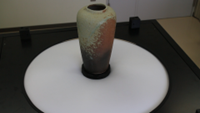
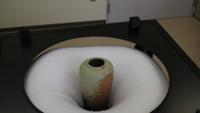
AL Seismic Isolation, Sate 1: AL Seismic Isolation, Sate 2:
the artwork being displayed the artwork being protected
2. Mitigation of Structural Damage Caused by Fault Displacement
When a large inland earthquake occurs at a shallow depth, structures may be damaged not only by shaking but also by fault displacement reaching the ground surface. When the ground surface is underlain by soft sedimentary layers, fault displacement may be absorbed within these layers, or its direction of propagation may change. The presence of a structure can also alter the way displacement reaches the surface.
Taking into account the influence of these surface sedimentary layers, this research aims to clarify the damage mechanisms of structures subjected to fault displacement and to investigate methods for mitigating such damage.

Numerical example: distribution of the region where large strain develops in the ground, shown as the green area in the figure above, when an upward fault displacement is applied at the bottom of the ground model in the presence of a heavy object representing an elevated bridge pier at the ground surface.
3. Seismic Performance Evaluation of Foundations Based on Soil–Structure Interaction
During an earthquake, not only the structure itself but also the supporting ground and foundation vibrate while interacting with one another. This phenomenon is known as soil–structure interaction, or SSI, and is important for accurately evaluating the seismic behavior of bridges and buildings. In pile foundations in particular, ground motion is transmitted to the structure through the piles, while the inertial force of the structure also acts back on the ground through the piles. Therefore, both the effects of ground deformation and structural inertia must be properly evaluated.
In this research, we use shaking-table model tests and numerical analysis to investigate the dynamic response of pile foundations, batter pile foundations, steel pipe sheet pile foundations, and other foundation systems. We also examine the influence of soil nonlinearity on foundation response, as well as seismic retrofitting methods in which micropiles are added to existing bridge foundations. Through these studies, we aim to establish safer and more rational design methods for foundation structures.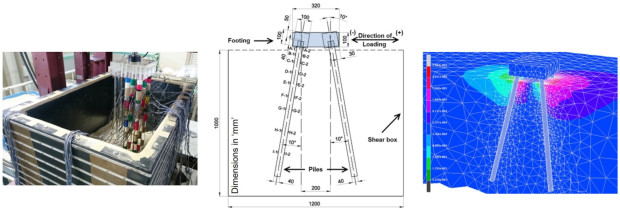
Experimental example: an instrumented model pile foundation installed in a laminar shear box.
Numerical example: a three-dimensional numerical model of a batter pile foundation and the distribution of horizontal displacement generated in the ground during shaking.
4. Disaster Preparedness and Support for Foreign Residents
The number of foreign nationals residing in Japan has continued to grow, exceeding four million as of the end of 2025. Disasters such as earthquakes, typhoons, and floods affect everyone, regardless of nationality. However, foreign residents may be more likely to face difficulties during disasters because of language barriers, limited access to disaster information, and weaker ties to local communities.
At the same time, foreign residents are diverse in nationality, language, cultural background, disaster experience, and degree of community engagement, and their disaster awareness and preparedness are by no means uniform. In this research, conducted jointly with Saitama City, we carry out questionnaire surveys and workshops with foreign residents living in the city, comparing and analyzing disaster-preparedness challenges by country of origin and community. Based on these findings, we are working with the city government to consider forms of information provision and support tailored to the characteristics of each community.
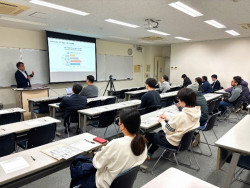
Workshop scene: Reporting survey results to foreign residents, followed by an exchange of views on disaster-preparedness challenges and the support needed (Filipino community, November 23, 2025).